1 / 3
JI
自
oneself
✎ Editor's glossoneself; by one's own hand
Naruto · Characters · Kanji file 030
Pronounced ji·ra·i·ya
Jiraiya takes his name from a figure of Edo-period fiction — a ninja who wields toad magic, beloved from the Edo period to this day in stories and kabuki. The Edo-period tale Jiraiya Gōketsu Monogatari stars the hero Jiraiya alongside his wife Tsunade and his nemesis Orochimaru, and this trio shaped many later works. In Naruto he is one of the Legendary Sannin — and again, deeply tied to toads. The character 油 ("oil") on his forehead is thought to nod to "toad oil," a wound salve sold in the Edo period. And according to the databook Rin no Sho, the author originally imagined Jiraiya as a "greasy" character — oil (油) and grease (脂) are both read abura in Japanese. The pun was there from the start.
📖 Databook: Rin no Sho, p. 73 · Tō no Sho, p. 92 · Sha no Sho, p. 90 · Jin no Sho, p. 108
Here's what each character means — and how to write it. In Japan, following the correct stroke order is considered the key to writing kanji beautifully. Readings, stroke counts and core meanings below come directly from the KANJIDIC2 dictionary database. The red ✎ line is the editor's gloss — the meaning that is actually alive in this name, chosen by our editors from a Japanese kanji dictionary.
✎ Editor's glossoneself; by one's own hand
✎ Editor's glossto come; to arise
✎ Editor's glossa classical ending character, common in men's names
What's next
We write in order of demand. Every name and jutsu in the official databooks is listed in our Master Index — find the one you want, and tell us via the Contact page.
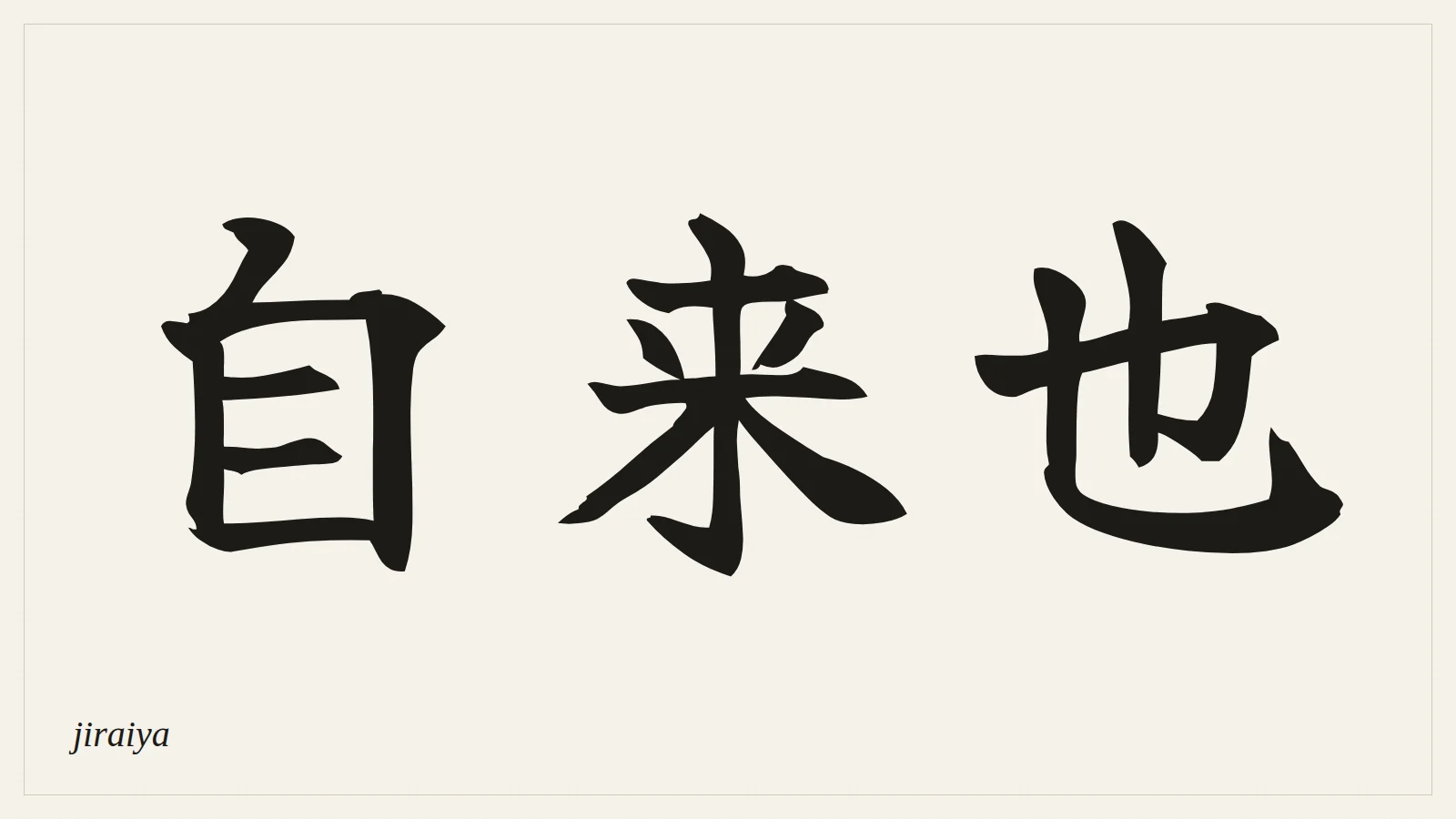
Original artwork — free to save
A reference card we drew ourselves — the characters in Japanese brush style.
Quick answers
16 in total: 自 is 6, 来 is 7, 也 is 3.
Say it ji·ra·i·ya (自来也). Japanese has no strong word stress: give each syllable about the same length and weight, and keep the vowels short and clear — a as in “father,” i as in “machine,” u as in “food,” e as in “met,” o as in “go.”
自来也 — 自, then 来, then 也. Core meanings from the KANJIDIC2 dictionary database: 自 oneself; 来 come · due; 也 to be (classical).
Yes — it's standard Unicode text and works on any modern OS. One caution before you print or ink it: make sure the font is a Japanese one. Some fonts render the same characters in Chinese style, and the difference shows.