1 / 2
MOKU
木
tree · wood
✎ Editor's glossa tree — wood itself
Naruto · Jutsu · Kanji file 061
Pronounced mo·ku·ton
Mokuton — "Wood Style" — is one of the classical five escapes of Japanese ninja lore: Katon, Suiton, Mokuton, Kinton, Doton — techniques for slipping away and hiding by means of something. In the old ninjutsu sense, Mokuton meant concealing yourself, and escaping, by means of trees and grasses. Here is the interesting twist: Naruto's five great nature transformations — Fire, Wind, Water, Lightning, Earth — are a different set, and wood is not among them. In Naruto, Mokuton is instead the secret bloodline art of the First Hokage, Hashirama Senju: a kekkei genkai that fuses water-nature and earth-nature chakra. And look at the kanji of Hashirama's name, 柱間 — the character 柱 (pillar) carries 木, the wood radical, inside it. That, we suspect, is exactly what the author intended.
Here's what each character means — and how to write it. In Japan, following the correct stroke order is considered the key to writing kanji beautifully. Readings, stroke counts and core meanings below come directly from the KANJIDIC2 dictionary database. The red ✎ line is the editor's gloss — the meaning that is actually alive in this name, chosen by our editors from a Japanese kanji dictionary.
✎ Editor's glossa tree — wood itself
✎ Editor's glossto flee, to slip away — the ton of tonjutsu, the ninja arts of escape
What's next
We write in order of demand. Every name and jutsu in the official databooks is listed in our Master Index — find the one you want, and tell us via the Contact page.
The whole family
Every Mokuton technique listed in the official databook index, with exact kanji and romaji. Stroke-order animations and native commentary will come to each of them — the Master Index tracks the promise.
| 神・樹界降誕 | Shin Jukaikōtan“Deep Forest Emergence of God” |
| 仙法木遁・真数千手 頂上化仏 | Senpōmokuton Shinsūsenju Chōjōkebutsu |
| 多重木遁分身の術 | Tajūmokutonbunshinnojutsu |
| 木遁・花樹界降臨 | Mokuton Kajukaikōrin“Wood Style: Flowering Tree World” |
| 木遁・挿し木の術 | Mokuton Sashikinojutsu |
| 木遁・四柱家の術 | Mokuton Shichūkanojutsu |
| 木遁・四柱牢の術 | Mokuton Shichūrōnojutsu |
| 木遁・大樹林の術 | Mokuton Daijurinnojutsu |
| 木遁の術 | Mokutonnojutsu |
| 木遁秘術・樹界降誕 | Mokutonhijutsu Jukaikōtan“Wood Style: Deep Forest Emergence” |
| 木遁・榜排の術 | Mokuton Bōhainojutsu |
| 木遁・皆布袋の術 | Mokuton Hotebukuronojutsu |
| 木遁・黙殺縛りの術 | Mokuton Mokusatsushibarinojutsu |
| 木遁・木錠壁 | Mokuton Mokujōheki |
| 木遁・木人の術 | Mokuton Mokujinnojutsu |
| 木遁・木龍の術 | Mokuton Mokuryūnojutsu |
| 木遁・連柱家の術 | Mokuton Renchūkanojutsu |
| 木分身の術 | Mokubunshinnojutsu |
Mokuton is the most famous of the combined-nature kekkei genkai — but not the only one. Ice, Lava, Boil, Magnet, Storm, Particle and more each carry a handful of jutsu of their own; you'll find every one of them in the Master Index.
0 of 18 covered so far — requests decide the order (→ Contact)
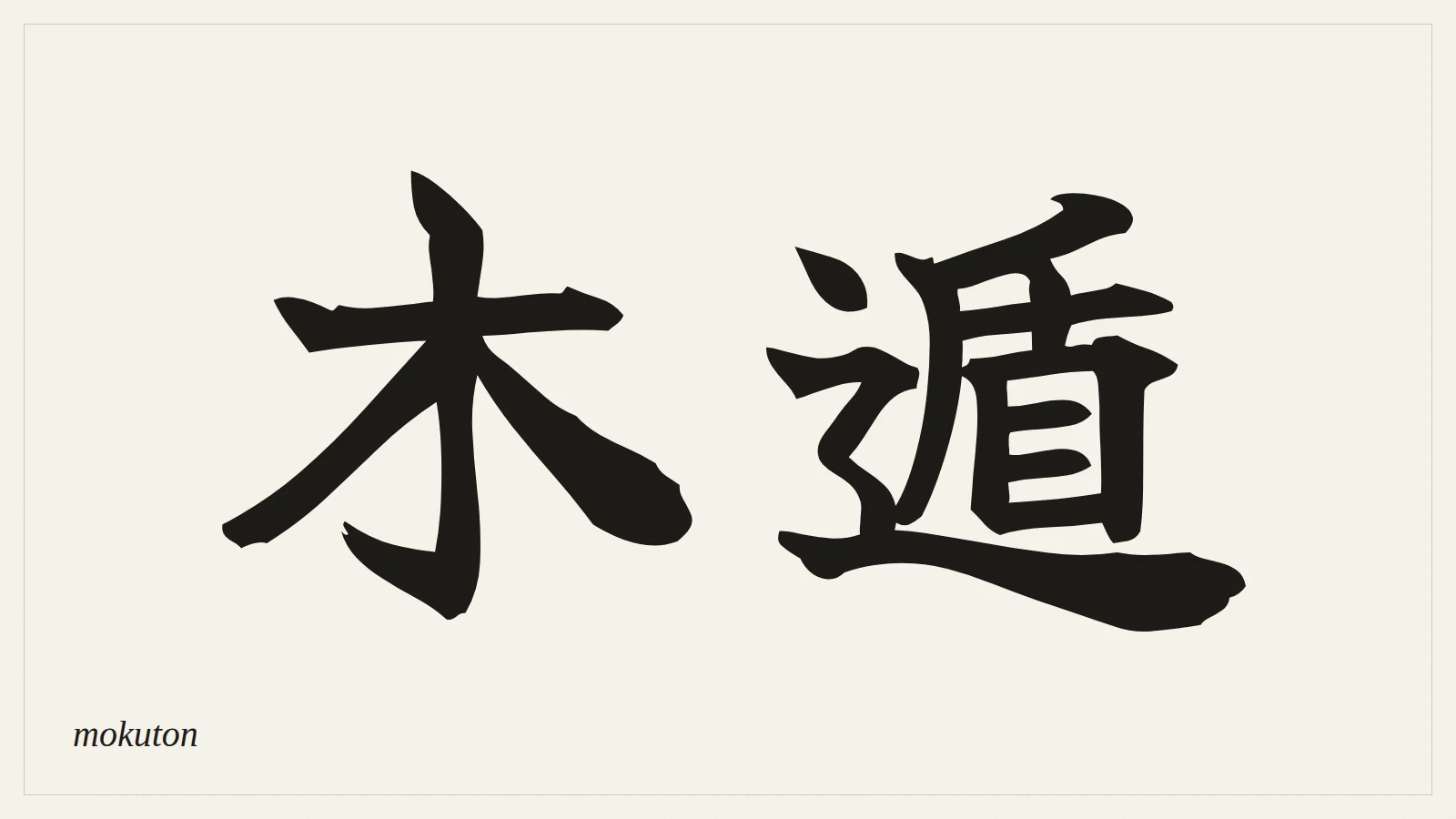
Original artwork — free to save
A reference card we drew ourselves — the characters in Japanese brush style.
Quick answers
17 in total: 木 is 4, 遁 is 13. The animation above draws every stroke in dictionary order.
Say it mo·ku·ton (木遁). Japanese has no strong word stress: give each syllable about the same length and weight, and keep the vowels short and clear — a as in “father,” i as in “machine,” u as in “food,” e as in “met,” o as in “go.”
Mokuton is written 木遁: 木 (tree, wood); 遁 (flee). Readings and meanings come from the KANJIDIC2 dictionary database.
Yes — it's standard Unicode text and works on any modern OS. One caution before you print or ink it: make sure the font is a Japanese one. Some fonts render the same characters in Chinese style, and the difference shows.