1 / 5
RA
螺
spiral · snail shell
✎ Editor’s glossa spiral shell — and anything coiled in its shape
Naruto · Jutsu · Kanji file 016
Pronounced ra·sen shu·ri·ken
The Rasenshuriken is the Rasengan reshaped — Naruto changes the sphere’s form into that of a shuriken. A shuriken is a small blade thrown at the enemy: a real weapon, said to have been used by the ninja of old, and a fixture of ninja stories ever since. That Naruto forges his signature jutsu from the classic ninja weapon — that is the royal road of shōnen manga. The jutsu is born in the training that begins in volume 36, when Naruto adds his own chakra nature — wind — to the Rasengan: a change even the Fourth Hokage never managed to achieve. And in the story’s endgame, with the power of the Sage of Six Paths, it grows into the Sage Art: Super Tailed Beast Rasenshuriken. Sha no Sho (p. 298) adds a detail worth savoring: what looks like one giant shuriken is in truth a mass of countless microscopic blades — chakra honed into tiny sword-edges that sever the chakra network itself.
📖 Databook: Sha no Sho, p. 298 · Jin no Sho, p. 290
First appears: Vol. 37, Chapter 339
Here's what each character means — and how to write it. In Japan, following the correct stroke order is considered the key to writing kanji beautifully. Readings, stroke counts and core meanings below come directly from the KANJIDIC2 dictionary database.
✎ Editor’s glossa spiral shell — and anything coiled in its shape
✎ Editor’s glossto sweep around and come back — to circle
✎ Editor’s glossthe shu of shuriken — a small blade thrown at the enemy
✎ Editor’s glossthe ri of shuriken — a small blade thrown at the enemy
✎ Editor’s glossthe ken of shuriken — a small blade thrown at the enemy
What's next
We write in order of demand. Every name and jutsu in the official databooks is listed in our Master Index — find the one you want, and tell us via the Contact page.
Original artwork — free to save
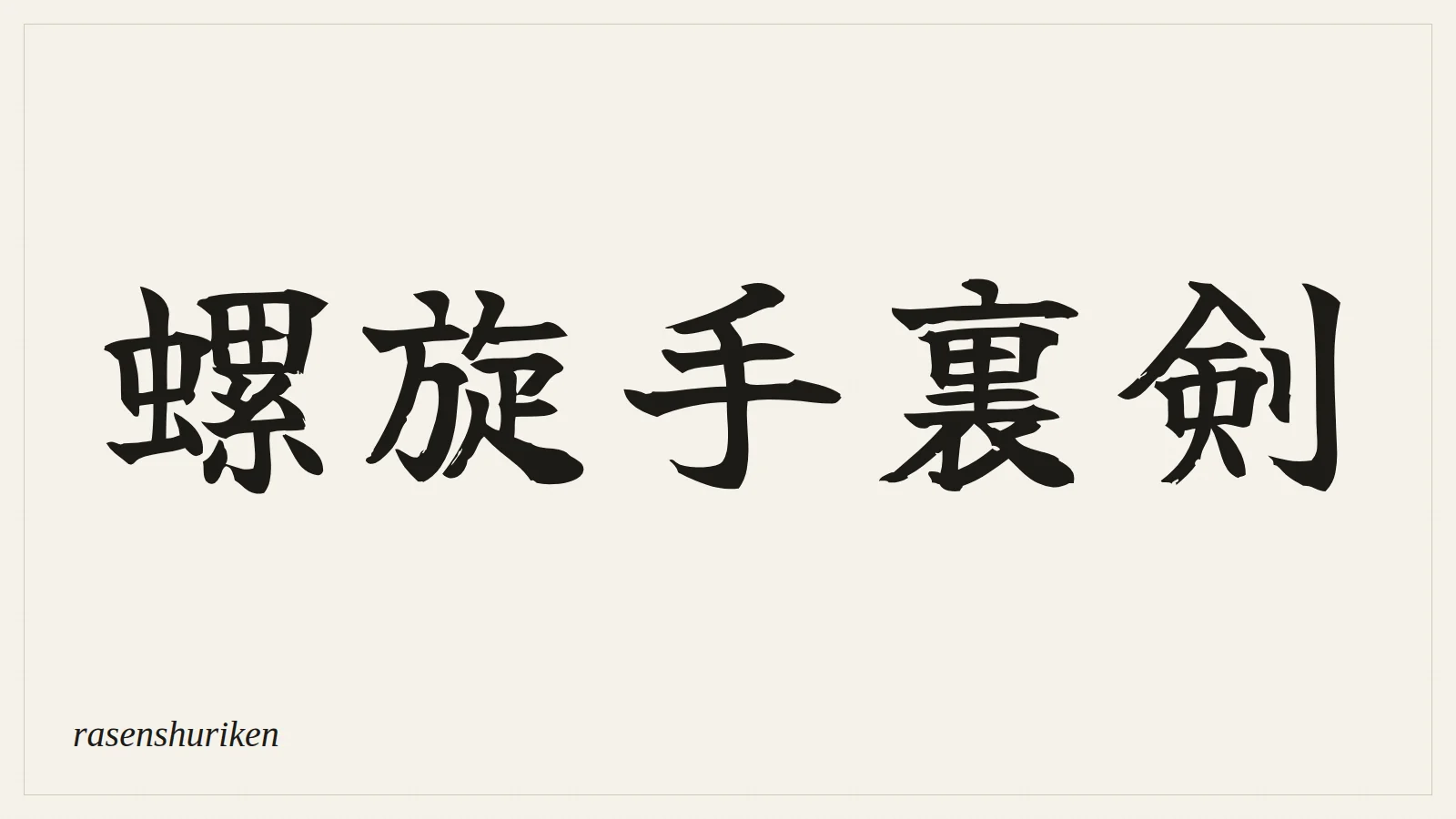
A reference card we drew ourselves — the characters in Japanese brush style.
Quick answers
55 in total: 螺 is 17, 旋 is 11, 手 is 4, 裏 is 13, 剣 is 10.
Say it ra·sen shu·ri·ken (螺旋手裏剣). Japanese has no strong word stress: give each syllable about the same length and weight, and keep the vowels short and clear — a as in “father,” i as in “machine,” u as in “food,” e as in “met,” o as in “go.”
螺旋手裏剣 — 螺, then 旋, then 手, then 裏, then 剣. Core meanings from the KANJIDIC2 dictionary database: 螺 small, edible, helical fresh-water mollusk; 旋 rotation · go around; 手 hand; 裏 back · amidst; 剣 sabre · sword.
Yes — it's standard Unicode text and works on any modern OS. One caution before you print or ink it: make sure the font is a Japanese one. Some fonts render the same characters in Chinese style, and the difference shows.