1 / 5
HACHI
八
eight
✎ Editor's glosseight
Naruto · Jutsu · Kanji file 018
Pronounced ha·chi·mon ton·kō no jin
Hachimon Tonkō is the author's own coinage, welding two nouns together. Hachimon is the Eight Gates — Kaimon, Kyūmon, Seimon, Shōmon, Tomon, Keimon, Kyōmon, Shimon. Tonkō traces back to China — to tonkō-shiki, better known as Qimen Dunjia: a classical system of warcraft and divination. Even to Japanese ears it is an arcane, unfamiliar word. And when the two nouns lock together, something happens to the sound. In English, we hear, it is rendered simply as Eight Gates — but in Japanese the cry is hachimon tonkō. Tell us that isn't a sound built for shouting! The state with the eighth gate — the Gate of Death — thrown open is called Hachimon Tonkō no Jin, the Eight Inner Gates Formation; and the one who went that far is, yes — that scene. The one that put every one of us on our feet. One more grace note: the jutsu named at the later gates — Asa Kujaku, the Morning Peacock, at the sixth; Hirudora, the Daytime Tiger, at the seventh; Sekizō, the Evening Elephant, and Yagai, Night Guy, at the eighth — names that walk from morning into night, adding their color to the whole design.
📖 Databook: Jin no Sho, p. 280
Here's what each character means — and how to write it. In Japan, following the correct stroke order is considered the key to writing kanji beautifully. Readings, stroke counts and core meanings below come directly from the KANJIDIC2 dictionary database.
✎ Editor's glosseight
✎ Editor's glossa gate — a building's entrance; also a school or lineage of learning
✎ Editor's glossto flee, to slip away
✎ Editor's glossa shell or carapace; East among the directions, Wood among the five elements
✎ Editor's glossa battle formation — the stance you take for war
What's next
We write in order of demand. Every name and jutsu in the official databooks is listed in our Master Index — find the one you want, and tell us via the Contact page.
Original artwork — free to save
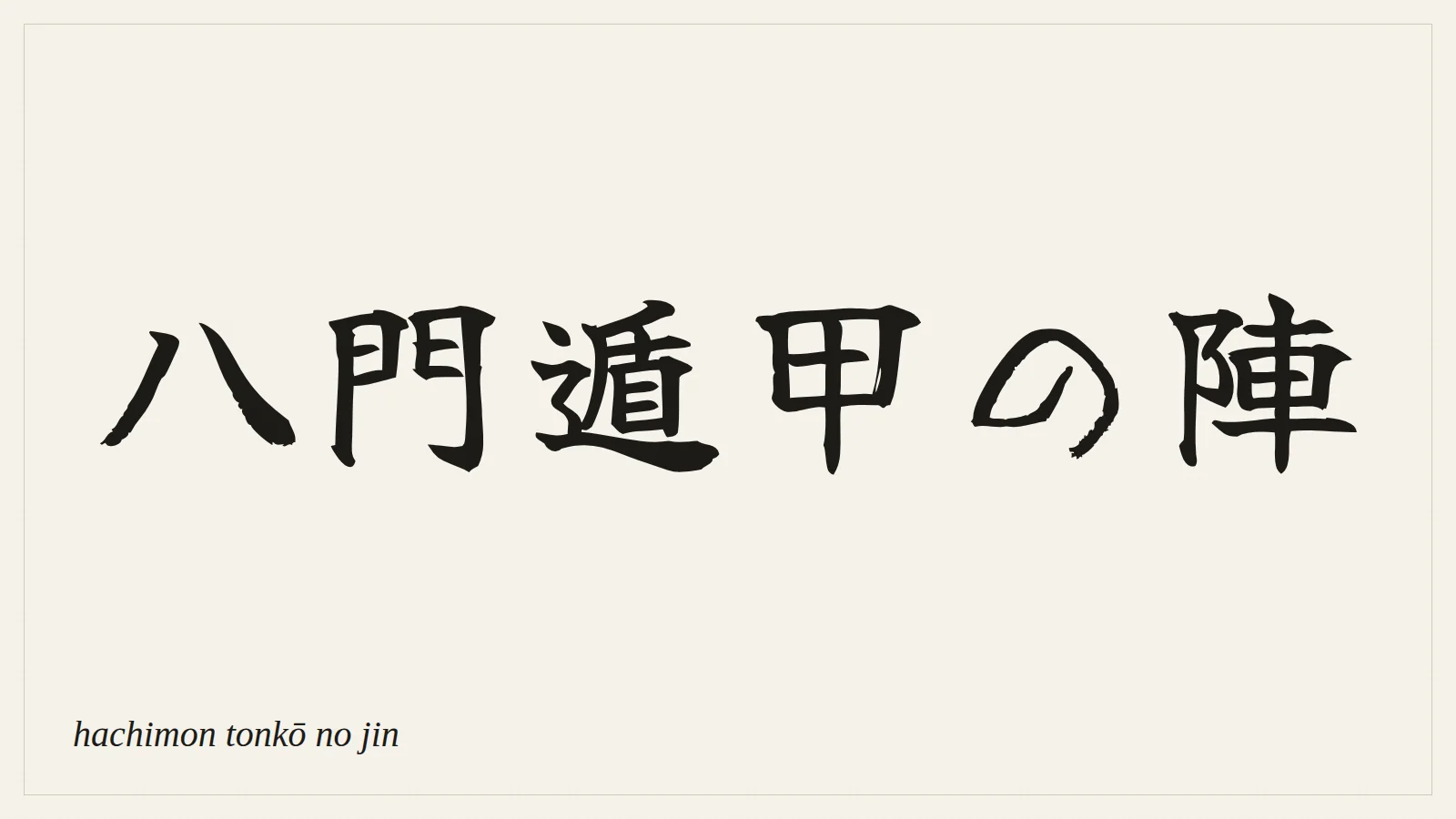
A reference card we drew ourselves — the characters in Japanese brush style.
Quick answers
38 kanji strokes in total: 八 is 2, 門 is 8, 遁 is 13, 甲 is 5, 陣 is 10 — plus the kana の, one stroke, drawn in between. The animation above draws every stroke in dictionary order.
Say it ha·chi·mon ton·kō no jin (八門遁甲の陣). Japanese has no strong word stress: give each syllable about the same length and weight, and keep the vowels short and clear — a as in “father,” i as in “machine,” u as in “food,” e as in “met,” o as in “go.” A vowel with a bar over it (ō, ū) is long: hold it for two beats.
Hachimon Tonkō no Jin is written 八門遁甲の陣: 八 (eight); 門 (gate); 遁 (flee); 甲 (shell, first sign); 陣 (battle formation). Readings and meanings come from the KANJIDIC2 dictionary database.
Yes — it's standard Unicode text and works on any modern OS. One caution before you print or ink it: make sure the font is a Japanese one. Some fonts render the same characters in Chinese style, and the difference shows.