1 / 4
SU
須
ought · by all means · necessarily
✎ Editor's glossto need; to call for
Naruto · Jutsu · Kanji file 010
Pronounced su·sa·no·o
Susanoo, too, is a god's name — held to be the mightiest god in Japanese mythology. When Izanagi purified himself, Amaterasu was born from his left eye, Tsukuyomi from his right, and Susanoo when he rinsed his nose: one of the Three Precious Children. God of the sea and of storms, he is called a heroic god by some and a god of destruction by others. Protector and rager — both faces live in this name. In Japan he is best known for slaying the eight-headed serpent Yamata no Orochi: he cut it down with a totsuka blade, found the sword Kusanagi inside the serpent's tail, and presented it to Amaterasu.
📖 Databook: Sha no Sho, p. 274
Here's what each character means — and how to write it. In Japan, following the correct stroke order is considered the key to writing kanji beautifully. Readings, stroke counts and core meanings below come directly from the KANJIDIC2 dictionary database. The red ✎ line is the editor's gloss — the meaning that is actually alive in this name, chosen by our editors from a Japanese kanji dictionary.
✎ Editor's glossto need; to call for
✎ Editor's glossto assist; to lend strength
✎ Editor's glossability; skill — being good at it
✎ Editor's glossa kanji borrowed purely for its sound — it spells the final 'o'
What's next
We write in order of demand. Every name and jutsu in the official databooks is listed in our Master Index — find the one you want, and tell us via the Contact page.
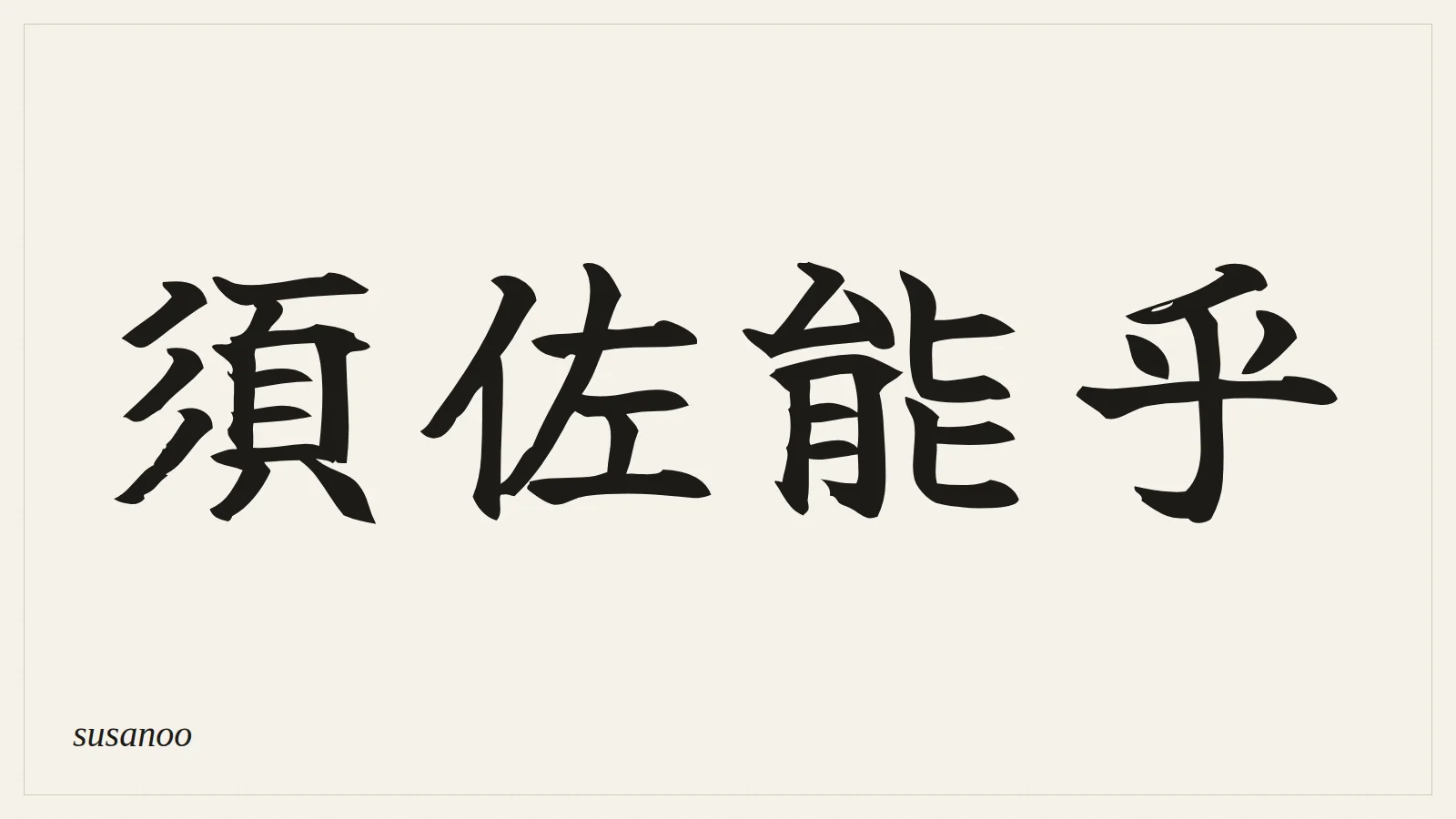
Original artwork — free to save
A reference card we drew ourselves — the characters in Japanese brush style.
Quick answers
In NARUTO it is 須佐能乎 — four kanji borrowed purely for their sounds (su·sa·no·o), the same way Japan’s oldest chronicles spelled the god’s name.
Say it su·sa·no·o (須佐能乎). Japanese has no strong word stress: give each syllable about the same length and weight, and keep the vowels short and clear — a as in “father,” i as in “machine,” u as in “food,” e as in “met,” o as in “go.”
34 in total: 須 is 12, 佐 is 7, 能 is 10, 乎 is 5.
須佐能乎 — 須, then 佐, then 能, then 乎. Core meanings from the KANJIDIC2 dictionary database: 須 ought · by all means; 佐 assistant · help; 能 ability · talent; 乎 question mark · ?.
Yes — it's standard Unicode text and works on any modern OS. One caution before you print or ink it: make sure the font is a Japanese one. Some fonts render the same characters in Chinese style, and the difference shows.