1 / 4
MU
無
nothingness · none · ain't
✎ Editor's glossnothing; without
Naruto · Jutsu · Kanji file 007
Pronounced mu·gen tsu·ku·yo·mi
Take Tsukuyomi and put 無限 — mugen, "infinite," without limit — in front of it. In Japan, mugen is also everyday slang for anything that never seems to end. So a Japanese reader sees the characters 無限月読 and reads it instantly: the ultimate, endless version of Tsukuyomi. In Jin no Sho it is described as the all-surveying eye of a god — the moon itself becomes a Rinne Sharingan, casting genjutsu over all humankind.
📖 Databook: Jin no Sho, p. 295
Here's what each character means — and how to write it. In Japan, following the correct stroke order is considered the key to writing kanji beautifully. Readings, stroke counts and core meanings below come directly from the KANJIDIC2 dictionary database.
✎ Editor's glossnothing; without
✎ Editor's glossa limit
✎ Editor's glossthe moon
✎ Editor's glossto read — to see what lies ahead
What's next
We write in order of demand. Every name and jutsu in the official databooks is listed in our Master Index — find the one you want, and tell us via the Contact page.
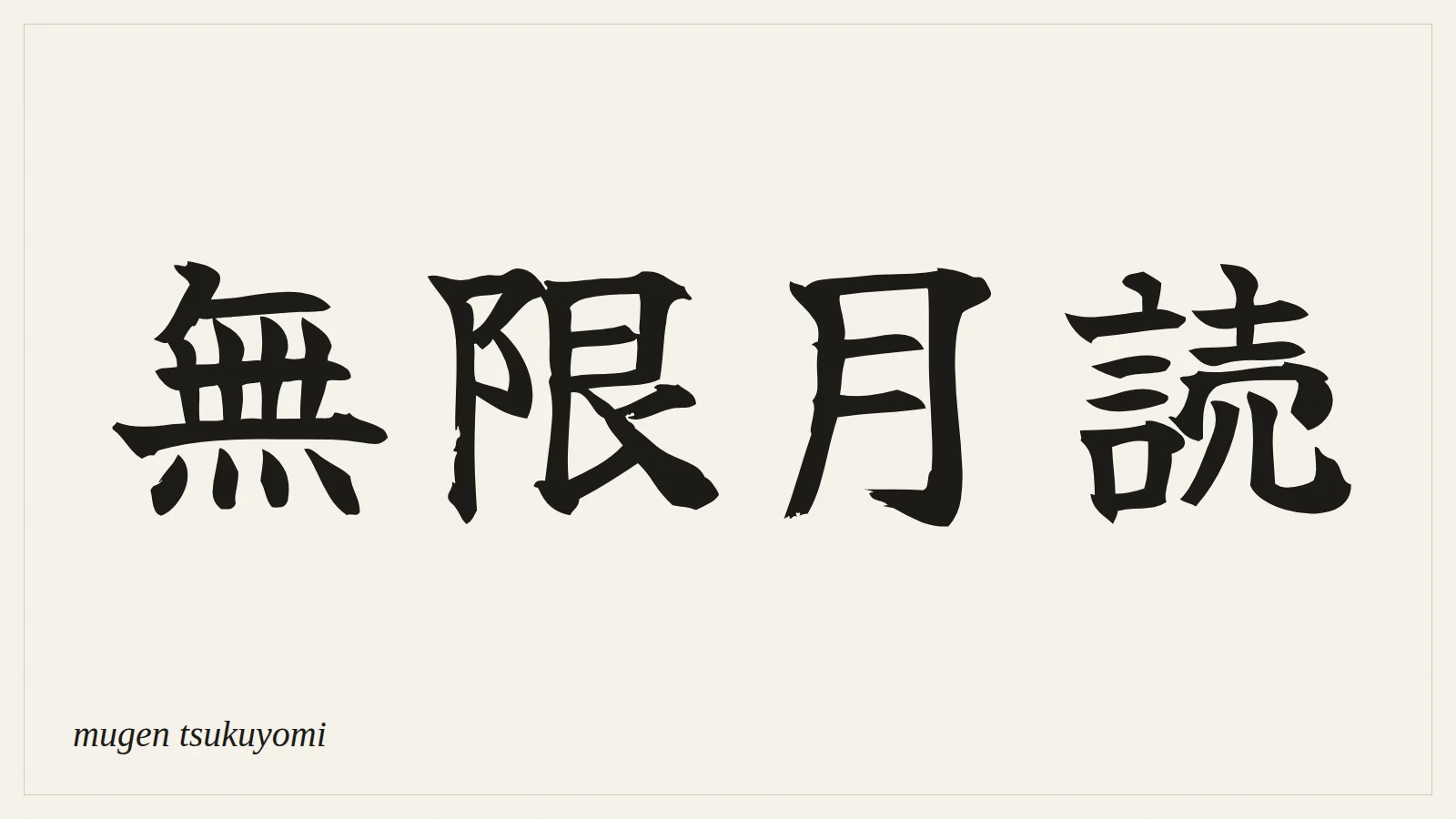
Original artwork — free to save
A reference card we drew ourselves — the characters in Japanese brush style.
Quick answers
39 in total: 無 is 12, 限 is 9, 月 is 4, 読 is 14.
Say it mu·gen tsu·ku·yo·mi (無限月読). Japanese has no strong word stress: give each syllable about the same length and weight, and keep the vowels short and clear — a as in “father,” i as in “machine,” u as in “food,” e as in “met,” o as in “go.”
無限月読 — 無, then 限, then 月, then 読. Core meanings from the KANJIDIC2 dictionary database: 無 nothingness · none; 限 limit · restrict; 月 month · moon; 読 read.
Yes — it's standard Unicode text and works on any modern OS. One caution before you print or ink it: make sure the font is a Japanese one. Some fonts render the same characters in Chinese style, and the difference shows.