1 / 2
DŌ
瞳
pupil of the eye
✎ Editor's glossthe pupil — the living center of the eye
Naruto · Jutsu · Kanji file 062
Pronounced dō·jutsu
Dōjutsu — eye techniques — are a delicacy Japanese anime and manga fans can never resist. The Jagan of Yu Yu Hakusho, the Geass of Code Geass, the third eye of 3×3 Eyes, the eye arts of The Kouga Ninja Scrolls — the list runs on and on. Elemental attacks of fire and water are easy to picture; eyes, though, hold infinite possibility — hypnosis, illusion, psychic power, seeing through walls, nullifying whatever they gaze upon. And among all Japanese works, it is Naruto that raised dōjutsu into a truly mighty category of its own: Sharingan, Byakugan, Rinnegan, Mangekyō Sharingan, Rinne Sharingan — rich in variety, each with powers and a character of its own. The Mangekyō alone commands the series' most beloved jutsu: Tsukuyomi, Amaterasu, Kagutsuchi, Kamui, Kotoamatsukami, Susanoo. And one more thing — each eye changes its very look as its bearer grows in level and power. To a Japanese fan, that detail is what we call emoi: it hits you right in the heart.
Here's what each character means — and how to write it. In Japan, following the correct stroke order is considered the key to writing kanji beautifully. Readings, stroke counts and core meanings below come directly from the KANJIDIC2 dictionary database. The red ✎ line is the editor's gloss — the meaning that is actually alive in this name, chosen by our editors from a Japanese kanji dictionary.
✎ Editor's glossthe pupil — the living center of the eye
✎ Editor's glossto flee, to slip away — the ton of tonjutsu, the ninja arts of escape
What's next
We write in order of demand. Every name and jutsu in the official databooks is listed in our Master Index — find the one you want, and tell us via the Contact page.
The whole family
The great eyes themselves, and the jutsu only those eyes can wield — every one as listed in the official databook index, with exact kanji and romaji. Rinne Sharingan lives beyond the four databooks' index, in the final act. The Master Index tracks the whole promise.
| The eyes | |
| 写輪眼 covered ✎ | Sharingan |
| 白眼 covered ✎ | Byakugan |
| 輪廻眼 covered ✎ | Rinnegan |
| 万華鏡写輪眼 covered ✎ | Mangekyōsharingan |
| The jutsu they command | |
| 月読 covered ✎ | Tsukuyomi |
| 天照 covered ✎ | Amaterasu |
| 炎遁・加具土命 covered ✎ | Enton Kagutsuchi |
| 神威 covered ✎ | Kamui |
| 別天神 | Kotoamatsukami |
| 須佐能乎 covered ✎ | Susanoo |
| 威装・須佐能乎 | Isō Susanoo |
| 完成体 須佐能乎 | Kanseitai Susanoo |
| イザナギ covered ✎ | Izanagi |
| イザナミ covered ✎ | Izanami |
| 幻術・写輪眼 | Genjutsu Sharingan |
| 口寄せ・輪廻眼 | Kuchiyose Rinnegan |
| 転写封印・天照 | Tenshafūin Amaterasu |
| 無限月読 covered ✎ | Mugentsukuyomi |
| 神楽心眼 | Kagurashingan |
12 of 19 covered so far — the best-lit room in the house Contact)
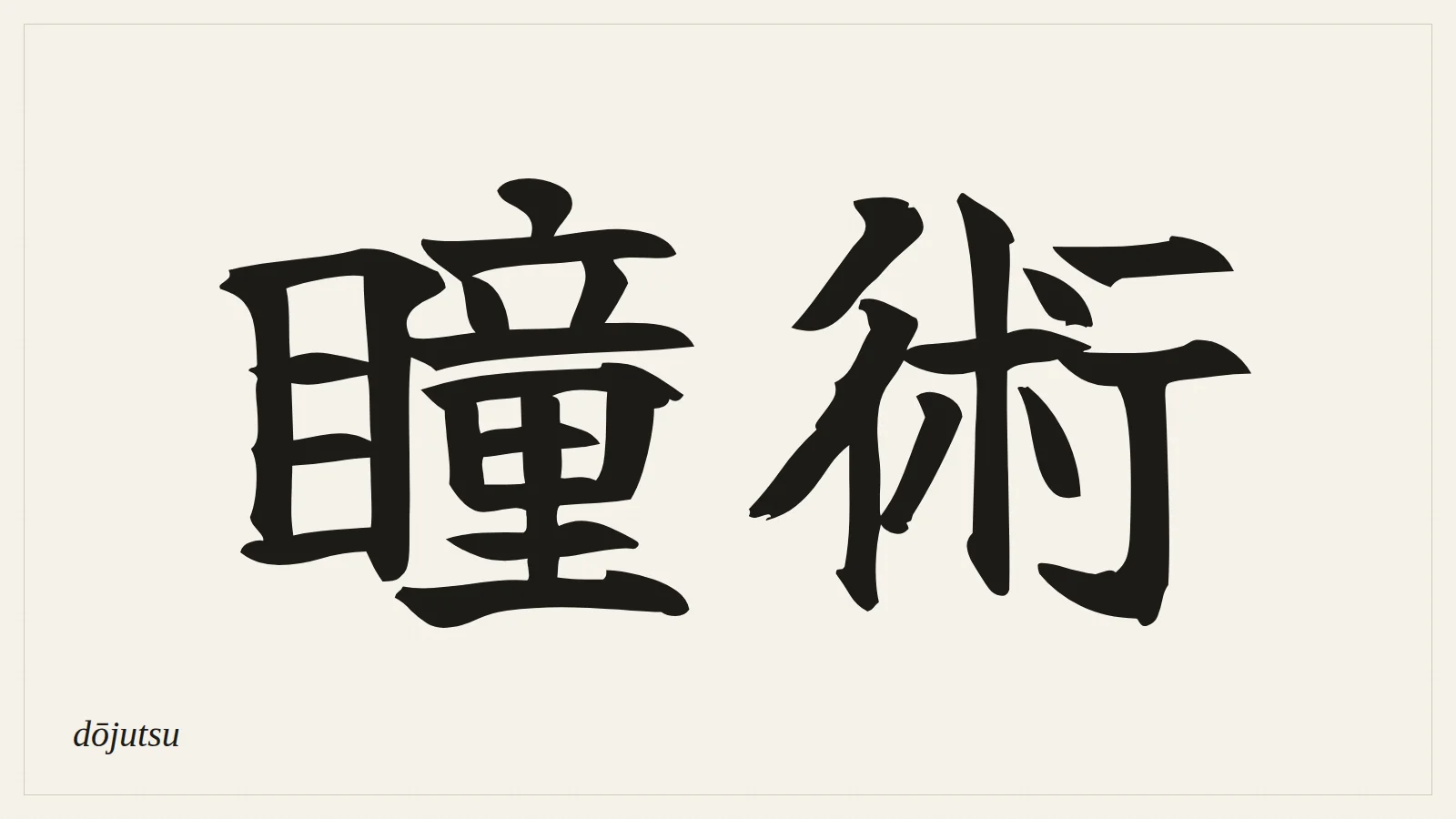
Original artwork — free to save
A reference card we drew ourselves — the characters in Japanese brush style.
Quick answers
28 in total: 瞳 is 17, 術 is 11. The animation above draws every stroke in dictionary order.
Say it dō·jutsu (瞳術). Japanese has no strong word stress: give each syllable about the same length and weight, and keep the vowels short and clear — a as in “father,” i as in “machine,” u as in “food,” e as in “met,” o as in “go.” A vowel with a bar over it (ō, ū) is long: hold it for two beats.
Dōjutsu is written 瞳術: 瞳 (pupil of the eye); 術 (art, technique). Readings and meanings come from the KANJIDIC2 dictionary database.
Yes — it's standard Unicode text and works on any modern OS. One caution before you print or ink it: make sure the font is a Japanese one. Some fonts render the same characters in Chinese style, and the difference shows.