1 / 2
KA
火
fire
✎ Editor's glossfire
Naruto · Jutsu · Kanji file 056
Pronounced ka·ton
Katon — "Fire Style" — is a staple of ninja fiction that long predates Naruto: fire-breathing ninjutsu, flame attacks. The history of real ninjutsu, however, tells a quieter story. Classical tradition speaks of the Goton no Jutsu, the five escapes — Katon, Suiton, Mokuton, Kinton, Doton — techniques for slipping away and hiding by means of fire, water, wood, metal or earth. In an interview on the official NARUTO site, the inheritor of a real ninjutsu lineage puts Katon like this: a technique for startling your opponent with fire — and escaping in that opening. In Naruto, the Uchiha and the Sarutobi clans of the Hidden Leaf are the great masters of Katon, and the sheer variety of its fire jutsu is what paints the series' battles so vividly.
🔗 Source: NARUTO Official Site — "Ask the Experts" interview with a real ninjutsu inheritor
Here's what each character means — and how to write it. In Japan, following the correct stroke order is considered the key to writing kanji beautifully. Readings, stroke counts and core meanings below come directly from the KANJIDIC2 dictionary database. The red ✎ line is the editor's gloss — the meaning that is actually alive in this name, chosen by our editors from a Japanese kanji dictionary.
✎ Editor's glossfire
✎ Editor's glossto flee, to slip away — the ton of tonjutsu, the ninja arts of escape
What's next
We write in order of demand. Every name and jutsu in the official databooks is listed in our Master Index — find the one you want, and tell us via the Contact page.
The whole family
Every Katon technique listed in the official databook index, with exact kanji and romaji. Stroke-order animations and native commentary will come to each of them — the Master Index tracks the promise.
| 火遁・炎弾 | Katon Endan |
| 火遁・蝦蟇油炎弾 | Katon Gamayuendan |
| 火遁・火龍炎弾 | Katon Karyūendan“Fire Style: Fire Dragon Flame Bomb” |
| 火遁・起爆炎陣 | Katon Kibakuenjin |
| 火遁・豪炎の術 | Katon Gōennojutsu |
| 火遁・豪火球の術 | Katon Gōkakyūnojutsu“Fire Style: Fireball Jutsu” |
| 火遁・豪火滅却 | Katon Gōkamekkyaku |
| 火遁・豪火滅失 | Katon Gōkamesshitsu |
| 火遁・豪龍火の術 | Katon Gōryūkanojutsu“Fire Style: Dragon Flame Jutsu” |
| 火遁・頭刻苦 | Katon Zukokku |
| 火遁・大炎弾 | Katon Daiendan |
| 火遁・灰塵隠れの術 | Katon Haijingakurenojutsu |
| 火遁・灰積焼 | Katon Haisekishō“Fire Style: Burning Ash” |
| 火遁・爆風乱舞 | Katon Bakufūranbu |
| 火遁・鳳仙花爪紅 | Katon Hōsenkatsumabeni |
| 火遁・鳳仙火の術 | Katon Hōsenkanojutsu“Fire Style: Phoenix Flower Jutsu” |
| 火遁・龍炎放歌の術 | Katon Ryūenhōkanojutsu |
| 火遁・龍火の術 | Katon Ryūkanojutsu“Fire Style: Dragon Flame Jutsu” |
0 of 18 covered so far — requests decide the order (→ Contact)
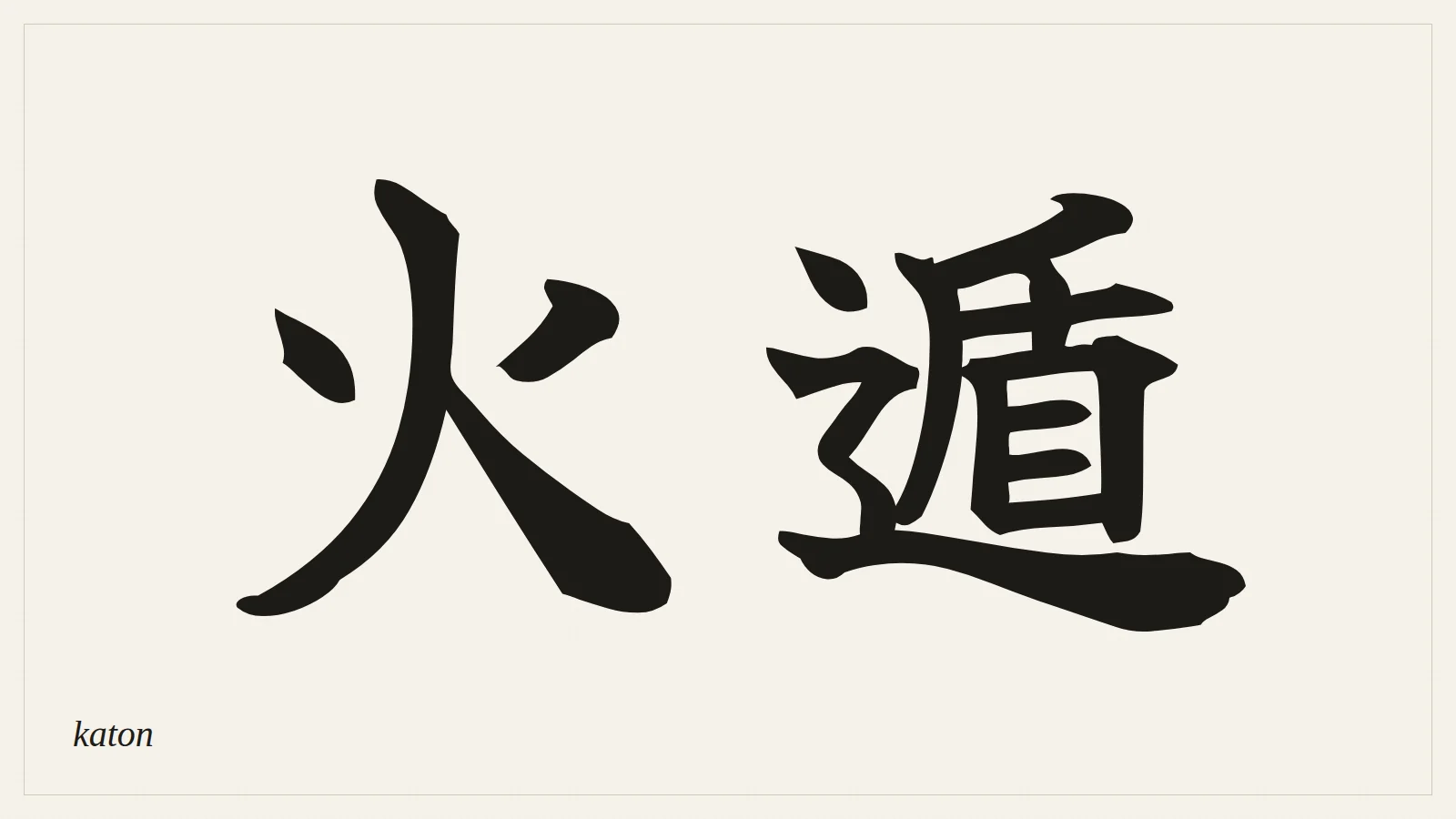
Original artwork — free to save
A reference card we drew ourselves — the characters in Japanese brush style.
Quick answers
17 in total: 火 is 4, 遁 is 13. The animation above draws every stroke in dictionary order.
Say it ka·ton (火遁). Japanese has no strong word stress: give each syllable about the same length and weight, and keep the vowels short and clear — a as in “father,” i as in “machine,” u as in “food,” e as in “met,” o as in “go.”
Katon is written 火遁: 火 (fire); 遁 (flee · escape · evade). Readings and meanings come from the KANJIDIC2 dictionary database.
Yes — it's standard Unicode text and works on any modern OS. One caution before you print or ink it: make sure the font is a Japanese one. Some fonts render the same characters in Chinese style, and the difference shows.