1 / 5
KŌ
黄
yellow
✎ Editor’s glossyellow; gold — and in 黄泉 (yomi), the place the dead go
Naruto · Jutsu · Kanji file 026
Pronounced yo·mo·tsu hi·ra·sa·ka
In Japanese mythology, Yomotsu Hirasaka is the boundary between Yomi — the land of the dead — and the world of the living. In the Kojiki, it appears in the scene where Izanagi flees from Yomi, escaping Izanami. And it is not only a story: a site said to be Yomotsu Hirasaka exists to this day, in Iya, Higashiizumo-chō, Matsue City, Shimane Prefecture. In NARUTO, it is a jutsu wielded by Kaguya Ōtsutsuki, letting her move at will between six different dimensions. Jin no Sho (p. 302) explains that it can be put to use in every kind of situation — to evade, to confuse, to strike by surprise.
📖 Databook: Jin no Sho, p. 302
Here's what each character means — and how to write it. In Japan, following the correct stroke order is considered the key to writing kanji beautifully. Readings, stroke counts and core meanings below come directly from the KANJIDIC2 dictionary database.
✎ Editor’s glossyellow; gold — and in 黄泉 (yomi), the place the dead go
✎ Editor’s glossa spring of water; the world after death — and in 黄泉 (yomi), the place the dead go
✎ Editor’s glossto compare; to liken one thing to another
✎ Editor’s glossgood; also a husband, a long while, truly
✎ Editor’s glossa slope
What's next
We write in order of demand. Every name and jutsu in the official databooks is listed in our Master Index — find the one you want, and tell us via the Contact page.
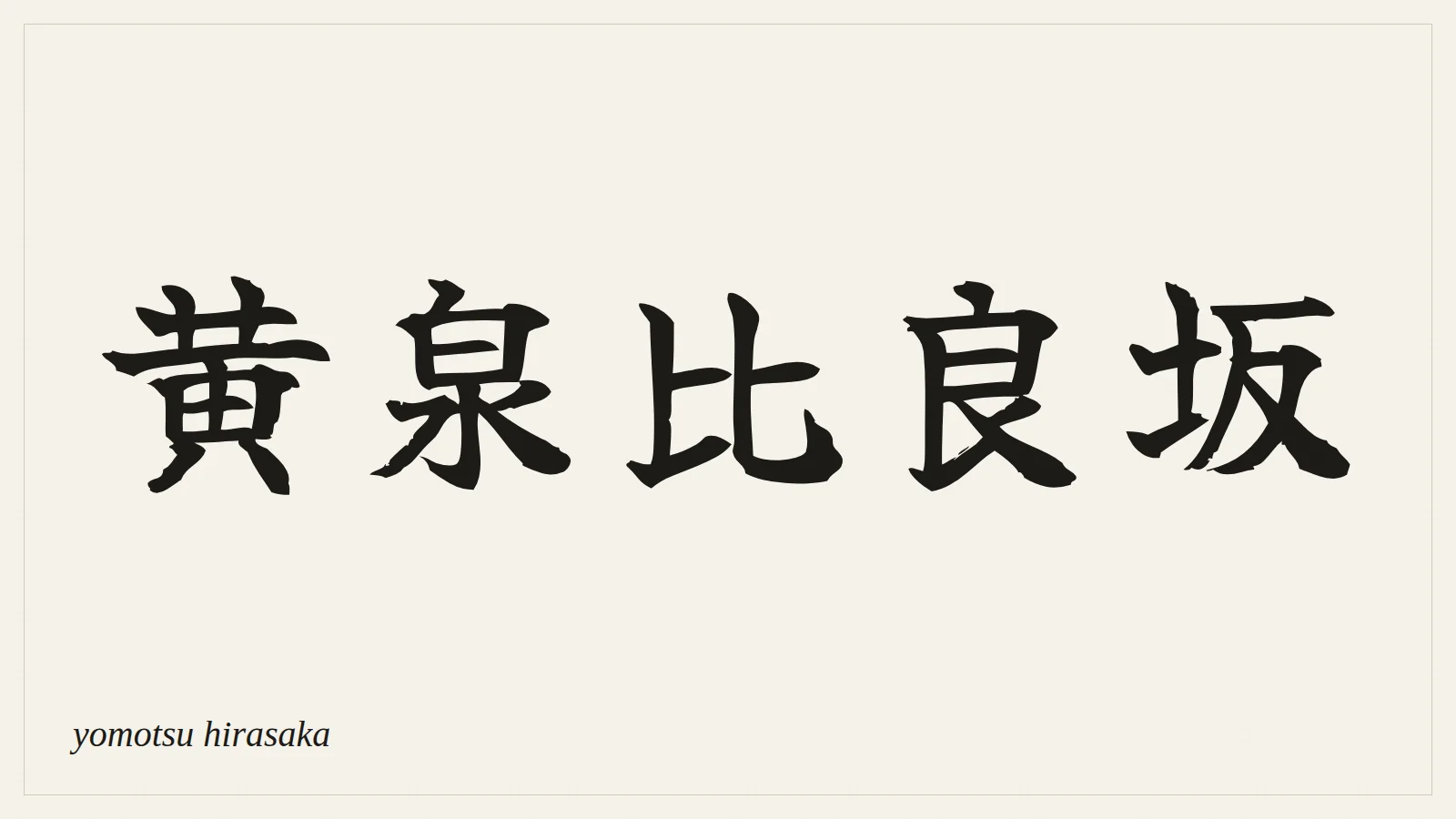
Original artwork — free to save
A reference card we drew ourselves — the characters in Japanese brush style.
Quick answers
38 in total: 黄 is 11, 泉 is 9, 比 is 4, 良 is 7, 坂 is 7.
Say it yo·mo·tsu hi·ra·sa·ka (黄泉比良坂). Japanese has no strong word stress: give each syllable about the same length and weight, and keep the vowels short and clear — a as in “father,” i as in “machine,” u as in “food,” e as in “met,” o as in “go.”
黄泉比良坂 — 黄, then 泉, then 比, then 良, then 坂. Core meanings from the KANJIDIC2 dictionary database: 黄 yellow; 泉 spring · fountain; 比 compare · race; 良 good · pleasing; 坂 slope · incline.
Yes — it's standard Unicode text and works on any modern OS. One caution before you print or ink it: make sure the font is a Japanese one. Some fonts render the same characters in Chinese style, and the difference shows.