1 / 3
KYŪ
九
nine
✎ Editor's glossnine
Naruto · Shinobi · Kanji file 046
Pronounced ku·ra·ma
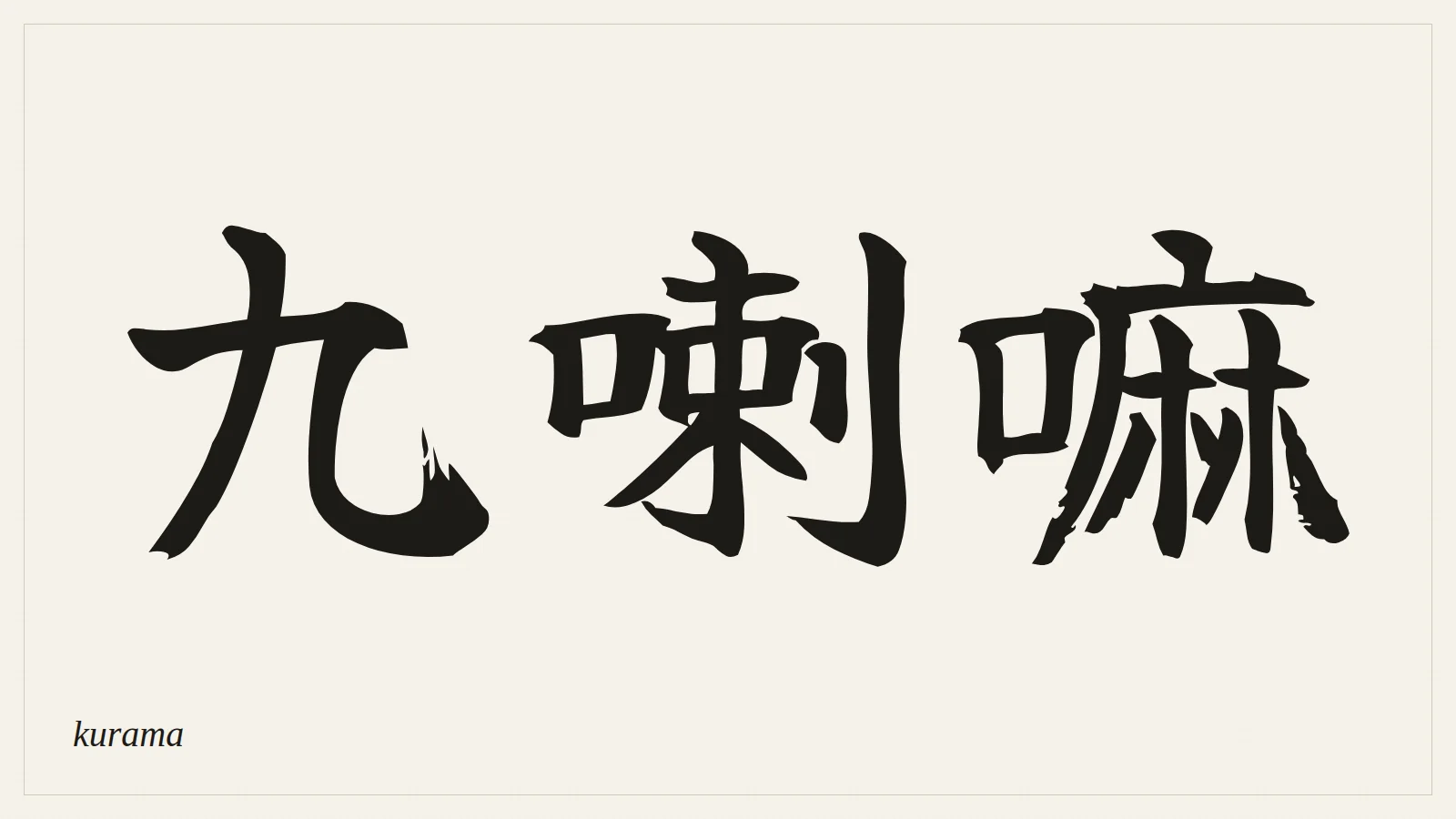
Kurama — written 九喇嘛 — lines up kanji that even Japanese readers have never laid eyes on. The word 喇嘛 comes by way of Tibetan: it means a high monk of Tibetan Buddhism — the very lama of the Dalai Lama, who is held to be the reincarnation of the bodhisattva Kannon. Naruto joins that 喇嘛 to the 九 of the Nine-Tails (九尾), and 九喇嘛 is born. Through the story's middle he is called simply the Nine-Tails; only late in the tale is it revealed that the fox carries a name of his own. Manga fans will hear another echo, too: the sound kurama calls up Kurama of Yu Yu Hakusho — himself a fox spirit. And in Kyoto there rises Mt. Kurama, a sacred mountain wrapped in tengu legends — the place where, one tradition holds, the guardian deity Sanat Kumara descended from Venus 6.5 million years ago. For none of this can we find any official word from the author or his staff — and that is precisely why the sound kurama is such delicious fuel for the imagination.
📖 Databook index: listed only as Kurama Mode — Jin no Sho, p. 250
Here's what each character means — and how to write it. In Japan, following the correct stroke order is considered the key to writing kanji beautifully. Readings, stroke counts and core meanings below come directly from the KANJIDIC2 dictionary database.
✎ Editor's glossnine
✎ Editor's glossone half of 喇嘛 — “lama,” a high monk of Tibetan Buddhism
✎ Editor's glossthe other half of 喇嘛 — the same “lama”
What's next
We write in order of demand. Every name and jutsu in the official databooks is listed in our Master Index — find the one you want, and tell us via the Contact page.
Original artwork — free to save
A reference card we drew ourselves — the characters in Japanese brush style.
Quick answers
28 in total: 九 is 2, 喇 is 12, 嘛 is 14.
Say it ku·ra·ma (九喇嘛). Japanese has no strong word stress: give each syllable about the same length and weight, and keep the vowels short and clear — a as in “father,” i as in “machine,” u as in “food,” e as in “met,” o as in “go.”
九喇嘛 — 九, then 喇, then 嘛. Core meanings from the KANJIDIC2 dictionary database: 九 nine; 喇 chatter · rattle on; 嘛 wheat.
Yes — it's standard Unicode text and works on any modern OS. One caution before you print or ink it: make sure the font is a Japanese one. Some fonts render the same characters in Chinese style, and the difference shows.