1 / 4
SHI
屍
corpse
✎ Editor's glossa corpse
Naruto · Jutsu · Kanji file 022
Pronounced shi·ki fū·jin
Combine 屍 (corpse) with 鬼 (demon) and you get shiki — not a word you'll find in everyday Japanese, but the characters alone conjure some powerful kind of demon. In Naruto it takes form as that white-robed Reaper — a visual that matches the kanji 屍鬼 perfectly. And here's the real point: instead of 封印 (fūin), the ordinary Japanese word for "seal," this jutsu uses a coined word — 封尽 (fūjin). That final character means "to be used up, to give everything": not just a seal, but a seal paid for with your life. The resolve of the Third and the Fourth Hokage is written into the name itself. Japanese fans love a cool four-character compound — and this one delivers twice over: the kanji look sharp on the page, and the sound, shiki fūjin, is superb.
Here's what each character means — and how to write it. In Japan, following the correct stroke order is considered the key to writing kanji beautifully. Readings, stroke counts and core meanings below come directly from the KANJIDIC2 dictionary database. The red ✎ line is the editor's gloss — the meaning that is actually alive in this name, chosen by our editors from a Japanese kanji dictionary.
✎ Editor's glossa corpse
✎ Editor's glossthe spirit of the dead; a man-eating demon — the oni
✎ Editor's glossto seal; to shut in
✎ Editor's glossto be used up; to give everything
What's next
We write in order of demand. Every name and jutsu in the official databooks is listed in our Master Index — find the one you want, and tell us via the Contact page.
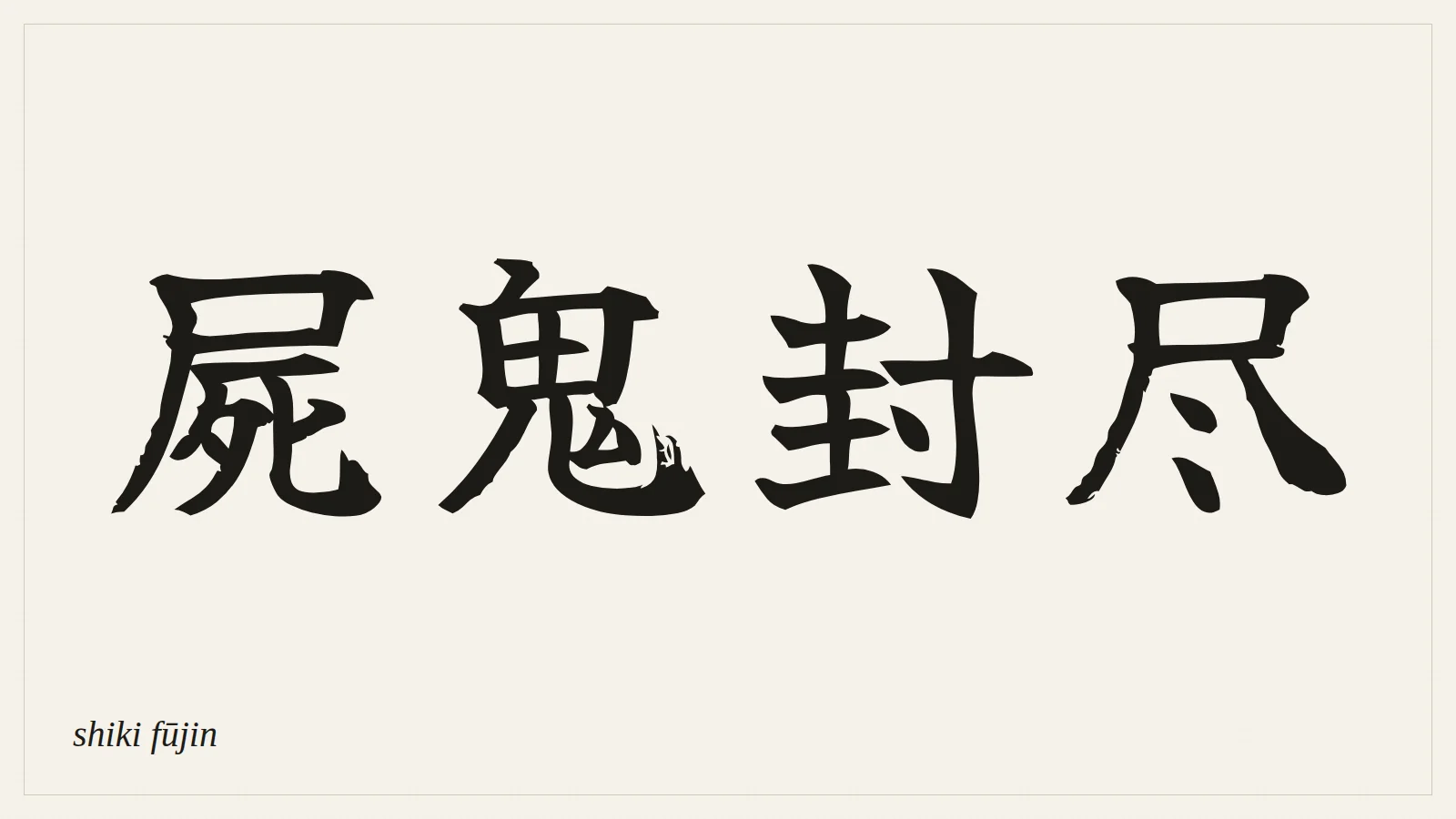
Original artwork — free to save
A reference card we drew ourselves — the characters in Japanese brush style.
Quick answers
屍鬼封尽 — 屍 corpse, 鬼 demon, 封 seal, 尽 to exhaust. Four characters you will not meet in everyday Japanese — which is exactly why it pays to double-check the font before you print or ink them.
Say it shi·ki fū·jin (屍鬼封尽). Japanese has no strong word stress: give each syllable about the same length and weight, and keep the vowels short and clear — a as in “father,” i as in “machine,” u as in “food,” e as in “met,” o as in “go.” A vowel with a bar over it (ō, ū) is long: hold it for two beats.
34 in total: 屍 is 9, 鬼 is 10, 封 is 9, 尽 is 6.
屍鬼封尽 — 屍, then 鬼, then 封, then 尽. Core meanings from the KANJIDIC2 dictionary database: 屍 corpse; 鬼 ghost · devil; 封 seal · closing; 尽 exhaust · use up.
Yes — it's standard Unicode text and works on any modern OS. One caution before you print or ink it: make sure the font is a Japanese one. Some fonts render the same characters in Chinese style, and the difference shows.