1 / 4
KYŪ
九
nine
✎ Editor's glossnine
Naruto · Shinobi · Kanji file 047
Pronounced kyū·bi no yō·ko
The nine-tailed fox is a legendary creature out of China: a divine beast bearing nine tails. In China, nine is an auspicious number, and the fox was long held to be a good omen — a herald of peace under heaven. As the centuries passed, though, it came to be told of as a monster that topples nations, too, and so it carries both blessing and calamity in one body. In Japan it appears in the Heian classics, and it has kept appearing ever since — through the medieval era, the early modern era, into the present. To Japanese readers, the nine-tailed fox is a character we meet again and again across countless works; and through the reach of the Chinese classics, it is known across much of Asia as well. In Naruto, it is the legendary monster fox that once drove the Hidden Leaf to the brink of ruin — sealed inside the protagonist, Naruto, and serving as the wellspring of his enormous chakra. In the story's second half, the fox is revealed to carry a name of his own: Kurama.
📖 Databook: Rin no Sho, p. 64 · Tō no Sho, p. 82 · Sha no Sho, p. 70
Here's what each character means — and how to write it. In Japan, following the correct stroke order is considered the key to writing kanji beautifully. Readings, stroke counts and core meanings below come directly from the KANJIDIC2 dictionary database.
✎ Editor's glossnine
✎ Editor's glossan animal's tail
✎ Editor's glossbewitching, uncanny — the yō of yōkai
✎ Editor's glossa fox
What's next
We write in order of demand. Every name and jutsu in the official databooks is listed in our Master Index — find the one you want, and tell us via the Contact page.
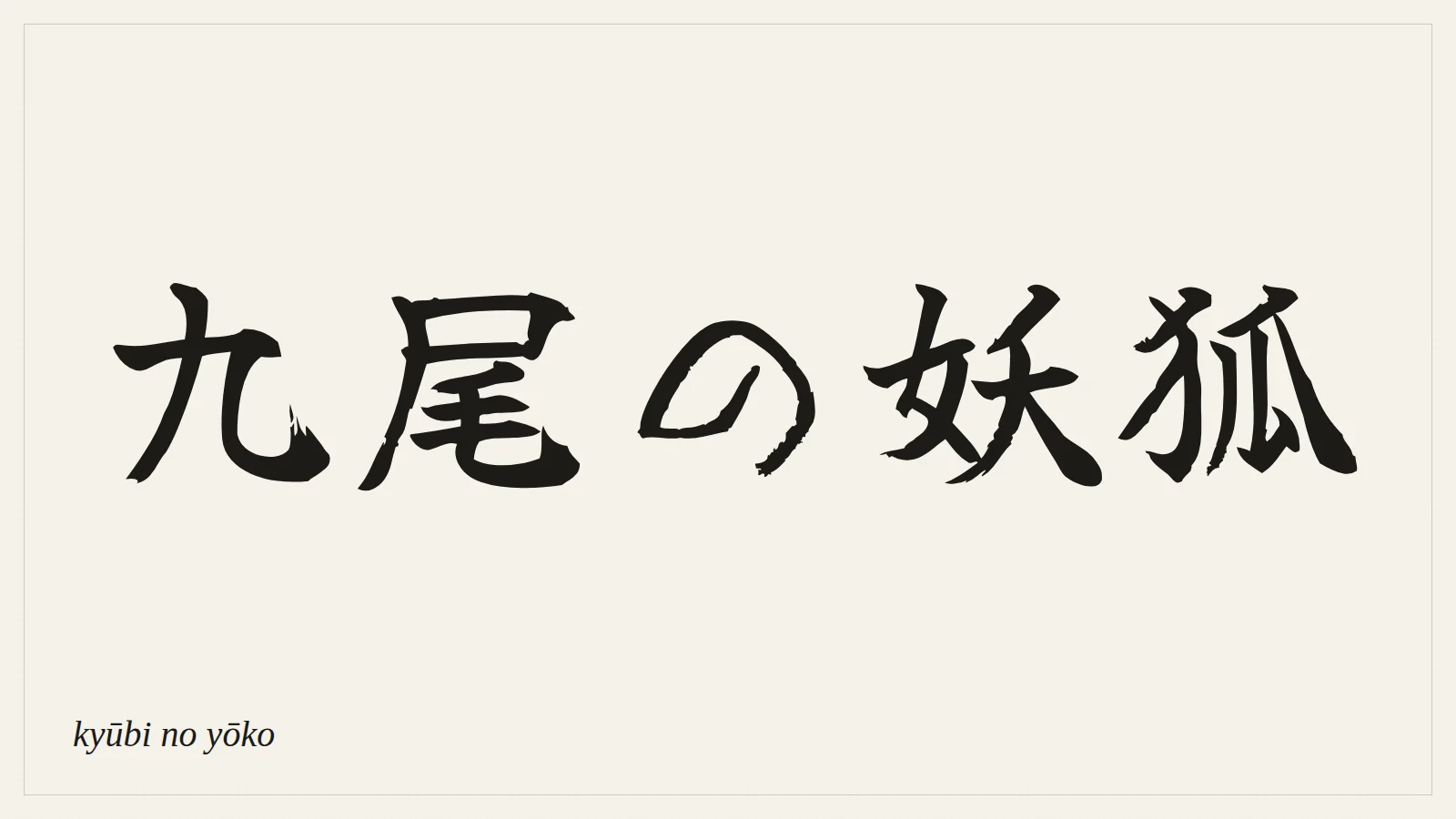
Original artwork — free to save
A reference card we drew ourselves — the characters in Japanese brush style.
Quick answers
26 in total: 九 is 2, 尾 is 7, の is 1, 妖 is 7, 狐 is 9.
Say it kyū·bi no yō·ko (九尾の妖狐). Japanese has no strong word stress: give each syllable about the same length and weight, and keep the vowels short and clear — a as in “father,” i as in “machine,” u as in “food,” e as in “met,” o as in “go.” A vowel with a bar over it (ō, ū) is long: hold it for two beats.
九尾の妖狐 — 九, then 尾, then の, then 妖, then 狐. Core meanings from the KANJIDIC2 dictionary database: 九 nine; 尾 tail · end; 妖 attractive · bewitching; 狐 fox.
Yes — it's standard Unicode text and works on any modern OS. One caution before you print or ink it: make sure the font is a Japanese one. Some fonts render the same characters in Chinese style, and the difference shows.