1 / 6
MAN
万
ten thousand
✎ Editor's glosscountless; myriad — all of them
Naruto · Dōjutsu · Kanji file 006
Pronounced man·ge·kyō sha·rin·gan
Mangekyō (万華鏡) is not a made-up word — it's the real Japanese word for a kaleidoscope. As a name for the next stage of the Sharingan, it doesn't get more stylish than this. In Tō no Sho it is described as holding the highest powers of the Eyes of Insight and Hypnotism, and as unlocking signature dōjutsu like Tsukuyomi and Amaterasu. Mid-story it was Itachi's calling card; from the second half on, as you all know, it becomes a key that moves the plot itself.
Here's what each character means — and how to write it. In Japan, following the correct stroke order is considered the key to writing kanji beautifully. Readings, stroke counts and core meanings below come directly from the KANJIDIC2 dictionary database. The red ✎ line is the editor's gloss — the meaning that is actually alive in this name, chosen by our editors from a Japanese kanji dictionary.
✎ Editor's glosscountless; myriad — all of them
✎ Editor's glossflower; beauty — radiance
✎ Editor's glossa mirror — it reflects things as they are
✎ Editor's glossto copy — an image, a form, a likeness
✎ Editor's glossa ring; a round thing — also "in turns"
✎ Editor's glossthe eye — the power to see through to the truth of things
What's next
We write in order of demand. Every name and jutsu in the official databooks is listed in our Master Index — find the one you want, and tell us via the Contact page.
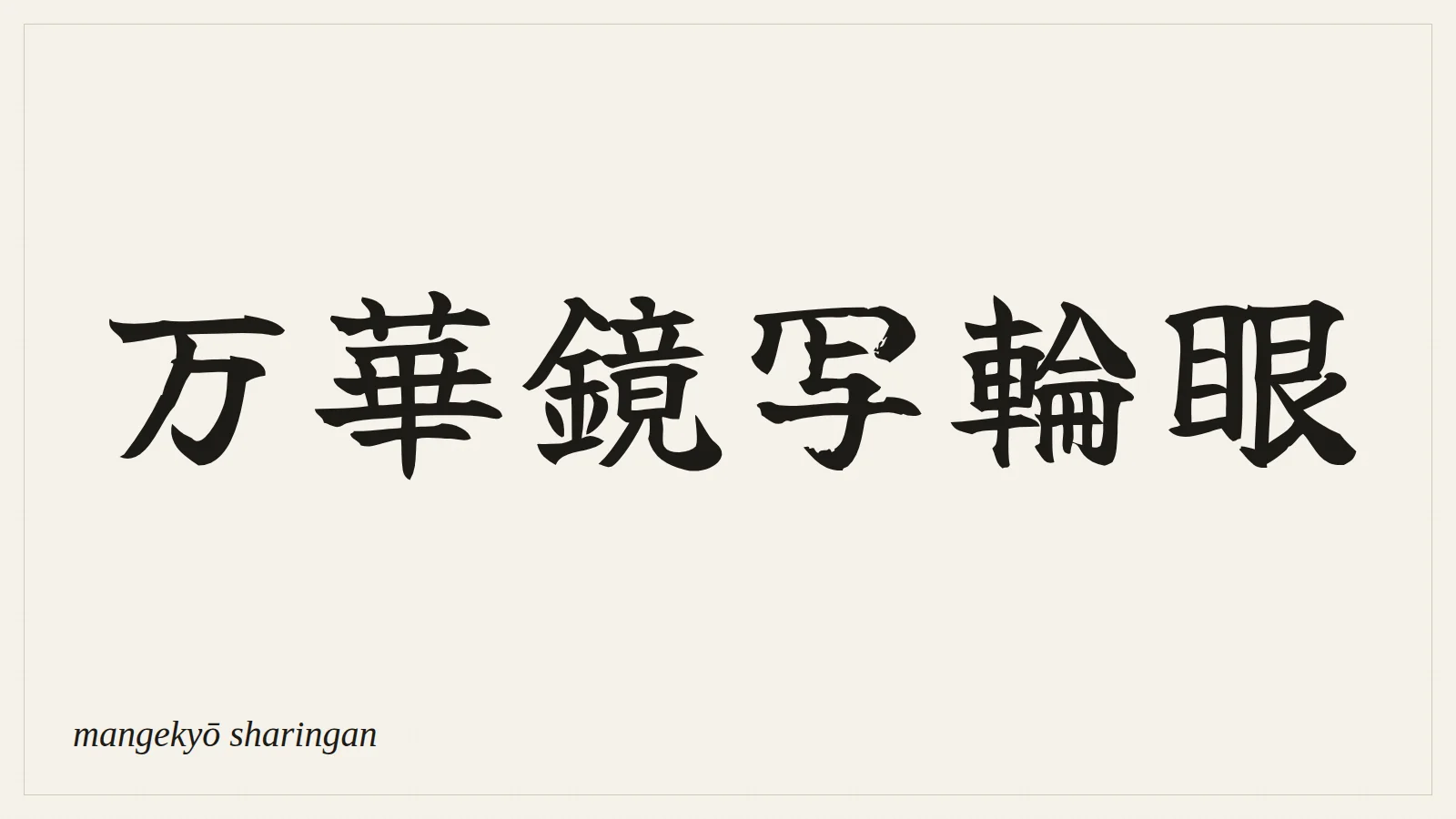
Original artwork — free to save
A reference card we drew ourselves — the characters in Japanese brush style.
Quick answers
63 in total: 万 is 3, 華 is 10, 鏡 is 19, 写 is 5, 輪 is 15, 眼 is 11. The animation above draws every stroke in dictionary order.
Say it man·ge·kyō sha·rin·gan (万華鏡写輪眼). Japanese has no strong word stress: give each syllable about the same length and weight, and keep the vowels short and clear — a as in “father,” i as in “machine,” u as in “food,” e as in “met,” o as in “go.” A vowel with a bar over it (ō, ū) is long: hold it for two beats.
Mangekyō Sharingan is written 万華鏡写輪眼: 万 (ten thousand); 華 (flower · splendor); 鏡 (mirror); 写 (to copy · to project); 輪 (wheel · ring); 眼 (eye). Readings and meanings come from the KANJIDIC2 dictionary database.
Yes — it's standard Unicode text and works on any modern OS. One caution before you print or ink it: make sure the font is a Japanese one. Some fonts render the same characters in Chinese style, and the difference shows.